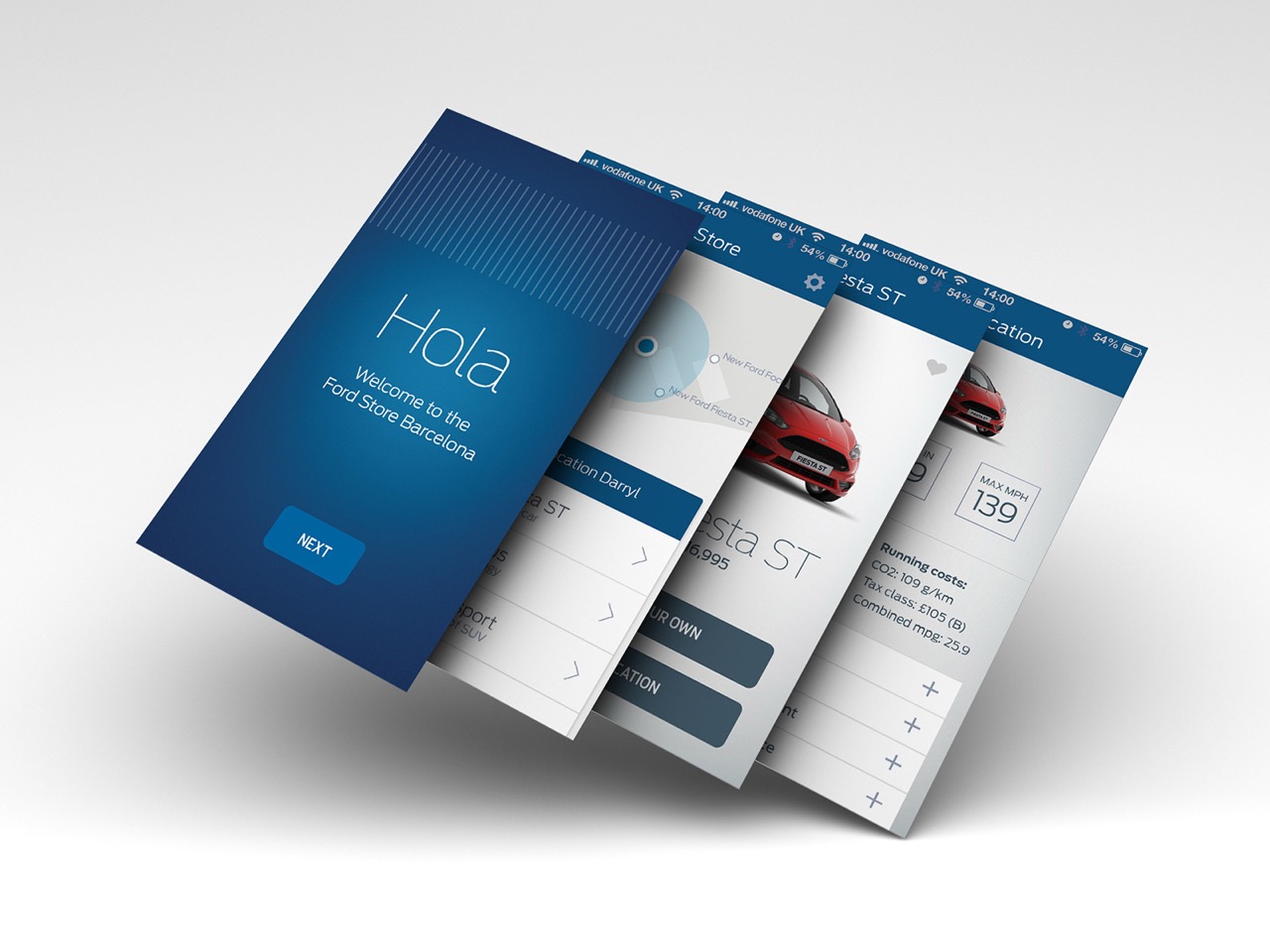
Re-imagining the Ford STore, Retailer show-room, with new tech


The challenge
Starting with a loose brief of “do something cool with Augmented Reality”, I secured a wider mandate to modernise the Ford Motor Company retailer showrooms with the new Ford Store, enhance motor show experiences, and improve the owner journey with integrated digital touch points.

My Role
I led ideation and rapid prototyping, working hands-on with designers and developers to experiment with new technologies and build testable demos. I oversaw in-situ testing and iteration, implemented the tech in a test Ford Store in Sant Just (Barcelona), managed installs at motor shows and marketing events, and then spent a month in Toronto with Pivotal Labs, building the initial Owners app that informed what is now Ford Pass.

Solution and Impact of the ford store
In the showroom, I introduced a social media “Hello Wall” that greeted customers, AR experiences to visualise wheel alloy changes on the vehicles, AR postcards to let users interact with the cars and change their colours, and iBeacon-driven contextual information around the cars.
These were connected to a Ford Store companion app, with throw to screen capability, and large configuration power walls, allowing customers to explore and personalise vehicles almost life-size. I adapted the Hello Wall and Ford Store app for international motor shows, adding In door mapping to help visitors to navigate the stand.
And evolved the FordStore experience into an initial Owners app, which ultimately became the customer-facing Ford Pass app.

Depth of technology
I used Aurasma Augmented Reality tech in combination with native iOS development in Objective C. The social media wall was built in HTML and Javascript, with a Java backend to aggregate, curate, and moderate the social media content. The mobile app was developed in Objective C for iOS, integrating iBeacons for proximity-based content, and VIN image recognition to tie specific vehicles to personalised digital experiences.

